Projection Light Certification: What Buyers Should Check Before Ordering
 FACEBOOK
 TWITTER
 LINKEDIN
When sourcing projection lights from China, many buyers ask suppliers a simple question: “Do you have CE, RoHS or FCC certification?”
But having a certificate is only the first step.
For importers, distributors and project buyers, the more important question is whether the certification documents actually apply to the specific product they are buying and the market where it will be sold.
After years of manufacturing and exporting projection lighting products, we have found that checking the documents carefully before placing an order can prevent many problems later.
1. Ask for Documents for the Exact Product Model
A common mistake is to receive a certificate from a supplier and assume that it covers the entire product range.
It may not.
For example, if you are purchasing a BL-3D01 3D projection light, the test report should identify the relevant product model. A report for another projector with a different power supply, PCB, light source or electrical design should not automatically be treated as proof of compliance for BL-3D01.
This is particularly important when different models look similar but have different internal components.
Always check the model number on the certification or test report.
2. The Target Market Matters
Certification requirements are also related to where the product will be sold.
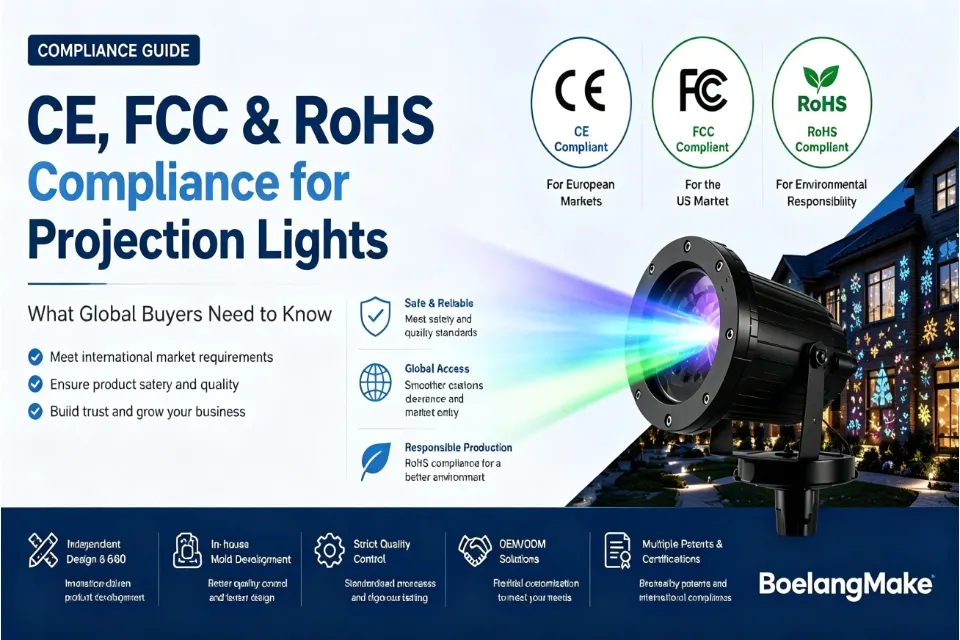
A product intended for the EU market may require documentation such as CE and RoHS, while products sold in the United States may require FCC compliance and other applicable requirements.
If you are selling through Amazon, TikTok Shop or other retail channels, your platform or local authorities may also ask for specific compliance documents.
Therefore, do not simply ask: “Is this product certified?”
Instead, tell your supplier: “We plan to sell this model in the US/EU market. Please provide the applicable compliance documents for this exact model.”
This gives the supplier a much clearer requirement.
3. Check the Power Adapter Separately
For projection lights that include an external power adapter, the adapter should not be overlooked.
The compliance documents for the main product do not necessarily mean that the included power adapter has the certifications required in your market.
When reviewing the documents, check:
- Product model
- Adapter model
- Input and output specifications
- Applicable testing standards
- Certification or test report number
This can become especially important when a buyer plans to replace the standard adapter with a different model for a particular market.
4. A Test Report Is Not Always the Same as a Certificate
Buyers sometimes use the words “certificate,” “test report” and “certification” interchangeably. They are not always the same thing.
A laboratory test report may show that a specific product was tested against certain standards. Other documents may be issued as declarations or certifications depending on the applicable regulation and market.
For this reason, buyers should look beyond a logo on the first page.
Check who issued the document, which model was tested, which standards were used, and whether the document is appropriate for your target market.
5. Ask Before You Place the Order
Certification problems are much easier to solve before production than after the goods have arrived.
Before placing an order, we recommend confirming:
Product model → Target market → Applicable requirements → Supporting documents
If you are planning to sell a projection light in the EU, US or another regulated market, make your requirements clear at the quotation stage.
This also helps the manufacturer confirm whether the current product configuration, power adapter and packaging are suitable for your market.
6. Choose a Manufacturer That Understands Compliance
For B2B buyers, compliance is not simply about collecting a few PDF files.
A reliable manufacturer should be able to tell you which documents belong to which product, what configuration was tested, and which market the documentation is intended for.
At BoelangMake, we manufacture projection lights and ambient lighting products for international B2B customers, with experience in product development, testing and export compliance.
Our recommendation is simple:
Don’t just ask whether a supplier has certifications. Ask whether the certification documents match your product, your configuration and your target market.
Before placing an order, always check that the documents match the exact product model, configuration and target market. This simple step can help avoid unnecessary compliance problems after shipment.