How to Read a CE Test Report: A Buyer’s Field Guide
 FACEBOOK
 TWITTER
 LINKEDIN
First, an important point: a CE test report is not a “CE certificate.”
Strictly speaking, CE marking is not issued as a single universal certificate. For products subject to CE marking requirements, the manufacturer is responsible for demonstrating conformity and, where required, preparing an EU Declaration of Conformity (DoC).
A test report is supporting evidence. It shows that a specific sample was tested against specific standards, usually by a specific testing laboratory, at a specific time.
For buyers, the important question is not simply “Does the supplier have a CE report?”
It is: “Does this report actually relate to the product I am buying?”
Here are seven things to check.
1. Check Who Issued the Report
Start with the testing laboratory.
Check the laboratory’s:
• Full legal name
• Address
• Report number
• Accreditation information, where applicable
If the report only shows a logo without clear laboratory information, ask the supplier for more details.
For testing laboratories, ISO/IEC 17025 accreditation can be useful evidence of laboratory competence for the relevant scope. However, accreditation alone does not automatically mean that a product complies with all applicable EU requirements.
2. Check the Applicant and Manufacturer
A test report may list both an Applicant and a Manufacturer.
These are not necessarily the same company.
Applicant: The company that commissioned or applied for the testing.
Manufacturer: The company identified as making the product.
If you are buying through a trading company, pay particular attention to the manufacturer information.
Ask a simple question:
“Is the product in this report actually manufactured by the factory that will produce my order?”
The names do not always have to be identical, but the relationship should be clear and traceable.
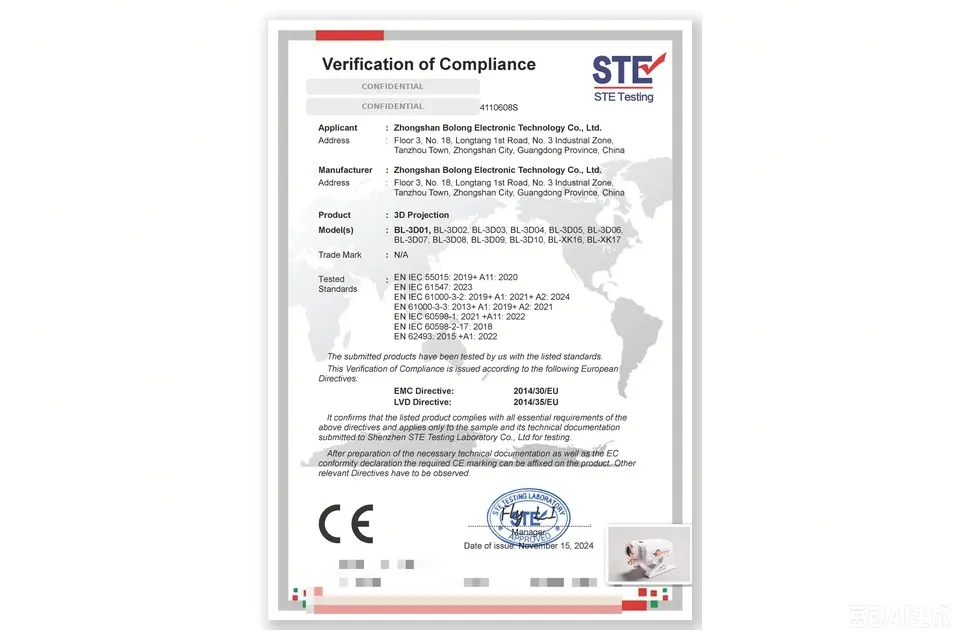
3. Check the Exact Product Model
This is one of the most important checks.
Look for the exact model number on the report.
Some reports cover several related models. If so, check:
- Is your model included?
- Are the models sufficiently identical in their relevant electrical and technical construction?
For example, different models may use different:
• Power adapters
• PCBs
• Light sources
• Optical systems
• Electrical components
Two products may look almost identical but still require different assessments.
Do not assume that a report for one projection light automatically covers another model.
4. Check the Test Standards
Next, look at the standards listed in the report.
For projection lighting products, depending on the product design and applicable requirements, you may see standards such as:
EN IEC 55015 — Radio disturbance characteristics of lighting equipment
EN IEC 61547 — EMC immunity requirements for lighting equipment
EN 61000-3-2 — Limits for harmonic current emissions
EN 61000-3-3 — Limits for voltage changes, voltage fluctuations and flicker
EN IEC 60598-1 — General requirements and tests for luminaires
EN IEC 60598-2-17 — Particular requirements for luminaires for stage, television, film and photographic studios
EN 62493 — Assessment of lighting equipment related to human exposure to electromagnetic fields
The applicable standards depend on the specific product.
Also check the edition and amendment of the standard shown in the report. For example:
EN IEC 60598-1:2021 + A11:2022
Using the correct and applicable version of a standard matters when assessing conformity for the relevant market and date of placing the product on the market.
5. Check the Applicable EU Requirements
CE marking is not based on one single test.
Depending on the product, its electrical characteristics and intended use, different EU legislation may apply.
For electrical projection lighting products, this may include requirements related to:
• EMC Directive 2014/30/EU
• Low Voltage Directive 2014/35/EU, where applicable
• RoHS Directive 2011/65/EU, as amended
Other requirements, such as energy efficiency or WEEE obligations, may also need to be considered depending on the product and market.
A professional supplier should be able to explain which requirements and documents apply to the specific product.
6. Check the Test Date and Product Version
A test report is a record of testing performed on a particular sample at a particular time.
This means buyers should also ask:
“Is the product being shipped today the same version that was tested?”
For example, if the manufacturer has changed the:
• Power adapter
• PCB
• Light source
• Main electronic components
• Electrical design
the manufacturer should evaluate whether the change affects the existing compliance assessment.
The same principle applies when relevant standards or regulatory requirements have been updated.
7. Read the Scope and Remarks
Do not stop at the first page.
Read the scope, remarks, notes and product description in the report.
Testing laboratories often make clear that the results apply to the sample and technical documentation submitted for testing.
This is important because a test report does not automatically guarantee that every product sold under a similar name is identical to the tested sample.
For buyers, this is perhaps the most useful lesson:
A genuine test report can still be the wrong test report for your order.
Test Report vs. Certificate vs. Declaration of Conformity
These documents are often confused, but they serve different purposes.
Test Report
Typically issued by: Testing laboratory
Main purpose: Records the testing performed on a specific sample against specified standards.
Certificate / Verification
Typically issued by: Laboratory or certification body, where applicable
Main purpose: Documents a specific assessment or certification scheme.
EU Declaration of Conformity (DoC)
Issued by: Manufacturer or authorized representative
Main purpose: Formal declaration of conformity with applicable EU legislation.
For a buyer, the test report is particularly useful because it contains technical details such as the product model, standards, test results and test date.
However, it should be reviewed together with the applicable Declaration of Conformity and other required compliance documentation.
What Should a Buyer Ask the Supplier?
Before placing a large order, ask the supplier to confirm:
- Does the report cover my exact product model?
- Who is the actual manufacturer?
- Which standards were used for testing?
- Which EU requirements does the documentation address?
- Is the tested product the same version as the production product?
These questions take only a few minutes to ask, but they can prevent much bigger problems later.
Compliance Starts with the Product
A test report is important, but compliance does not begin with a document.
It begins with product design, component selection, engineering control and consistent manufacturing.
At BoelangMake, we develop and manufacture projection lighting products for international B2B markets. We keep our testing and compliance documentation linked to the relevant product models and product versions.
If you are sourcing galaxy projectors, 3D projection lights, indoor ambient projectors or outdoor projection lighting, we recommend checking the actual product and its supporting documents together — not relying on a CE logo alone.
A CE mark is a visible sign of conformity. The details behind it are what a professional buyer should verify.