Outdoor Laser Projector Light for Garden Supplier: Projection Area and Lighting Distance
 FACEBOOK
 TWITTER
 LINKEDIN
When evaluating an Outdoor Laser Projector Light for Garden Supplier, projection area is often the first specification buyers notice. Yet a figure such as 15–200 m² (161–2152 sq. ft.) should not be interpreted as a fixed lighting boundary.
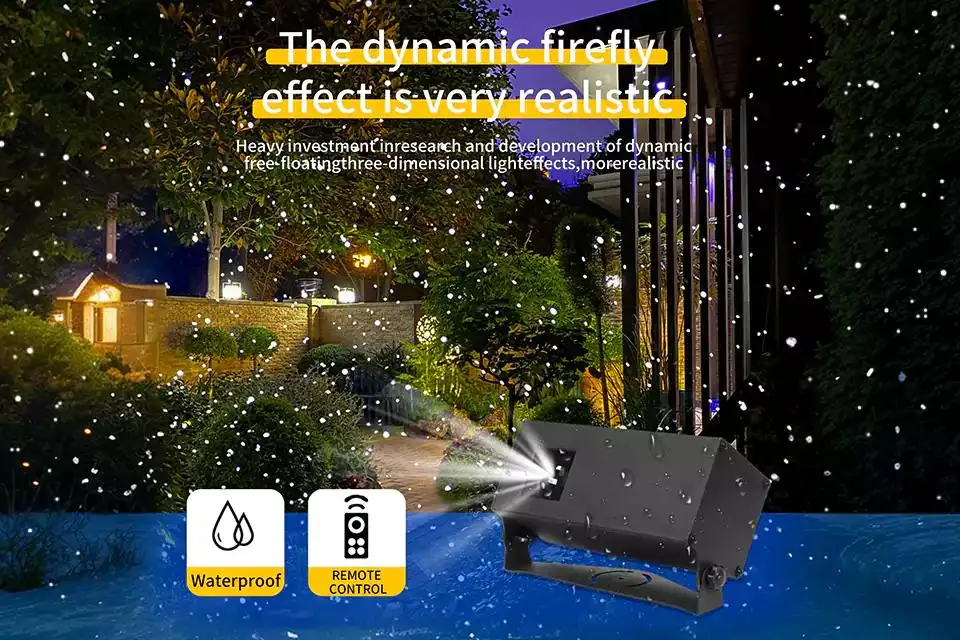
For outdoor laser projection, usable coverage is determined by several interacting variables:
•Projection distance;
•Optical spread angle;
•Projector-to-surface angle;
•Ambient illumination;
•Pattern density;
•Surface reflectivity and geometry;
•Required viewing contrast.
At BoelangMake, these factors are considered together during optical, mechanical, and control-system development. A projector covering 200 m² does not necessarily produce the same pattern density or visual impact as the same unit operating over 30–50 m².
What Does Projection Area Really Measure?
Projection area describes the approximate surface over which the projected laser pattern can be distributed under suitable operating conditions.
It does not mean that:
•Every point within the area has identical visual intensity;
•Maximum coverage is the optimum installation condition;
•Projection area is equivalent to brightness;
•The same coverage will be achieved on walls, grass, and trees.
For an Outdoor Laser Projector Light for Garden Supplier, a more useful technical question is therefore:
At what distance and surface condition does the projector provide the required combination of coverage, contrast, and pattern density?
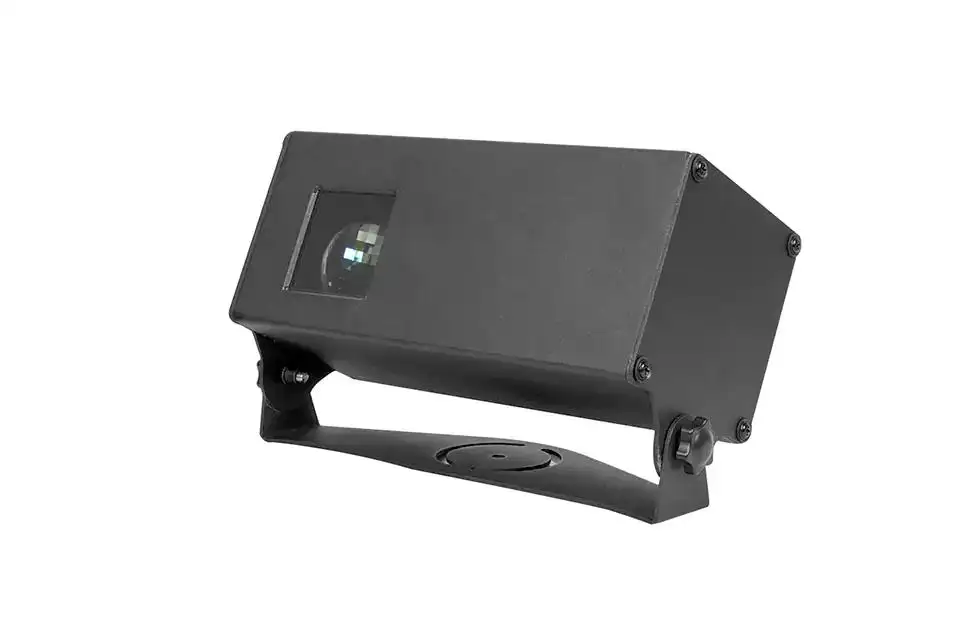
BoelangMake’s outdoor firefly projector, for example, specifies a projection range of approximately 15–200 m². The correct operating point within that range depends on the garden layout rather than the area specification alone.
How Projection Distance Changes Coverage and Pattern Density
Laser projection systems distribute optical points over an angular field. As the distance between projector and target increases, that field occupies a larger physical surface.
The relationship can be summarized as:
•Shorter distance: Smaller field, higher pattern density
•Medium distance: Balanced field size and density
•Longer distance: Wider field, lower point density
| Projection Condition | Coverage Area | Pattern Density | Visual Character | Typical Application |
| Short distance | Smaller | High | Concentrated, vivid | Patio, small wall |
| Medium distance | Moderate | Balanced | Even, immersive | Backyard, garden |
| Long distance | Large | Lower | Wide, atmospheric | Villa façade, landscape area |
This trade-off is important. Increasing distance expands the physical footprint, but the projected points are distributed across a larger surface.
An experienced Outdoor Laser Projector Light for Garden Supplier should therefore evaluate effective coverage, not simply maximum coverage.
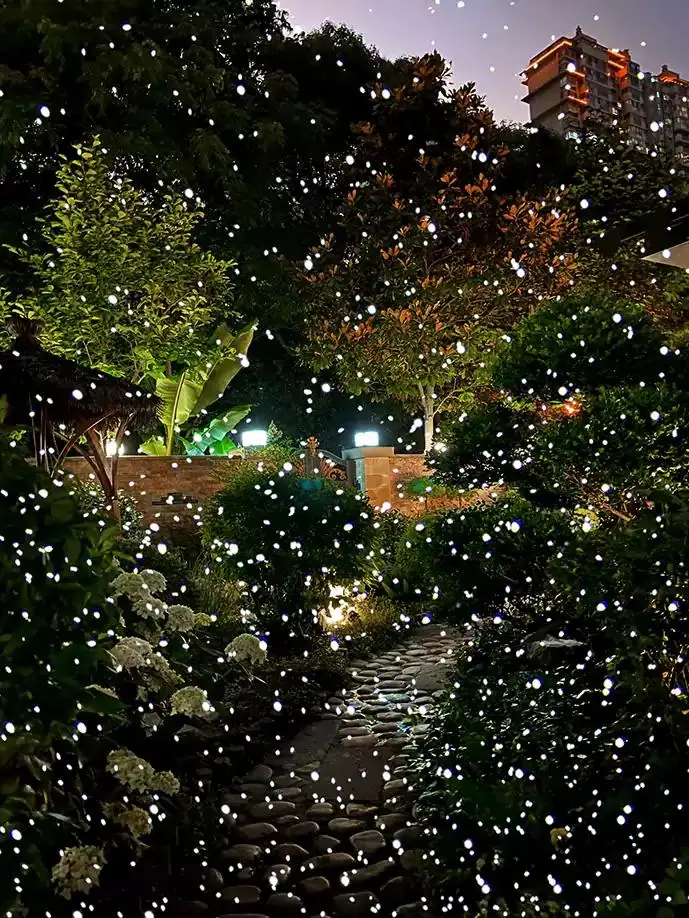
Why Maximum Distance Is Not Always Better
Moving the projector farther away can create three practical changes:
•Projected dots become more widely separated;
•Local visual density decreases;
•Ambient light becomes more influential because the effect is spread across a larger area.
For decorative landscape lighting, the design objective is usually not maximum square meters. It is sufficient spatial coverage without losing the intended firefly density and visual depth.
Ambient Light Determines Effective Garden Coverage
Outdoor laser effects rely heavily on contrast.
A dark garden with minimal competing illumination can show a pattern over a much larger apparent area than a space exposed to:
•Streetlights;
•Façade lighting;
•Illuminated windows;
•Pathway lamps;
•Nearby commercial signage.
This creates an important distinction:
Optical coverage is the area reached by the projected pattern; effective coverage is the area where that pattern remains visually useful.
When choosing an Outdoor Laser Projector Light for Garden Supplier, buyers should ask how the stated projection area relates to realistic nighttime conditions.
Projection Surface Changes the Result
Garden environments are optically more complex than a flat indoor wall.
Flat Walls
Walls provide a relatively stable projection plane and make it easier to evaluate:
•Pattern spacing;
•Edge distribution;
•Projected field dimensions;
•Motion uniformity.
Light-colored matte walls often make projected points easier to perceive than very dark or highly reflective surfaces.
Trees, Shrubs and Landscape Planting
Trees introduce multiple projection depths. Light can fall on:
•Foreground leaves;
•Internal branches;
•Rear foliage;
•Surrounding walls or ground surfaces.
This layered geometry produces a more three-dimensional effect, which is particularly useful for firefly-style projection.
BoelangMake’s outdoor firefly design combines floating, blinking, breathing, glowing, and moving effects so the light does not appear as a static field of points. Adjustable motion and brightness further allow the pattern to be adapted to the visual scale of the garden.
Projection Angle Can Distort the Effective Field
Distance alone is not enough to predict garden coverage.
When the optical axis is close to perpendicular to a wall, pattern distribution is relatively uniform. At a steep installation angle, the projected field becomes geometrically stretched.
This may cause:
•Denser patterns near the projector;
•Wider spacing at the far side;
•Elongated projection geometry;
•Uneven perceived brightness;
•Part of the optical field to fall outside the useful landscape area.
For this reason, a professional Outdoor Laser Projector Light for Garden Supplier should consider placement geometry together with projection distance.
One Large Projection Zone or Several Smaller Zones?
Large gardens frequently contain buildings, trees, pathways, fences, and different viewing directions. One projector operating at maximum spread may therefore be less effective than several controlled projection zones.
| Garden Layout | Main Technical Priority | Suitable Approach |
| Small patio | Pattern density | Shorter, concentrated projection |
| Open backyard | Density/coverage balance | Medium-distance placement |
| Villa façade | Broad field | Wider wall projection |
| Trees and shrubs | Spatial depth | Layered foliage projection |
| Irregular landscape | Uniform coverage | Multiple projection zones |
Multiple zones are particularly useful when obstacles create optical shadows or when viewers move through several parts of the garden.
Outdoor Engineering Goes Beyond Optical Coverage
An Outdoor Laser Projector Light for Garden Supplier must also account for repeated exterior operation.
Key engineering areas include:
Optical System
•Laser alignment;
•Pattern distribution;
•Dynamic effect consistency;
•Brightness adjustment.
Electronic and Motion Control
•Controlled animation speed;
•Timing functions;
•Cycle operation;
•Stable motor movement.
Mechanical Design
•Outdoor-oriented enclosure;
•Cable routing;
•Mounting stability;
•Protection against environmental exposure.
BoelangMake integrates semiconductor laser application R&D, electronic control, optical effect development, and enclosure engineering within its product development process.
Its manufacturing platform includes a 5000+ m² factory, 200+ patents, 15+ R&D engineers, and 5+ automated production lines, supported by 100% inspection and burn-in testing for production quality control.
Laser Safety Classification Is Not a Waterproof Rating
Technical specifications should separate optical safety from environmental protection.
Class 1 and IEC 60825-1 refer to laser product safety. They are not waterproof classifications.
Outdoor environmental protection should be verified separately through the applicable enclosure or IP documentation.
Likewise, buyers should confirm whether CE, FDA, RoHS, PSE, TÜV-related testing, FCC, UL, or other documentation applies to the exact model and configuration being purchased rather than assuming every certification covers every product.
BoelangMake combines BSCI/WCA factory credentials with experience supporting products for multiple international markets.
How Manufacturing Control Affects Real Projection Performance
For an Outdoor Laser Projector Light for Garden Supplier, optical consistency must continue from prototype to mass production.
Variation in any of the following can change the final effect:
•Laser-module alignment;
•Optical positioning;
•Motion-system stability;
•Electronic control;
•Housing assembly;
•Final functional calibration.
With more than 15 years of laser application and OEM/ODM experience, BoelangMake can also adapt projection effects, product appearance, housing color, functions, logo, and packaging according to project requirements.
Final Takeaway
Garden laser coverage should be engineered rather than simply maximized. Projection distance, optical spread, pattern density, ambient light, surface geometry, and installation angle must be evaluated together.
For brands, importers, distributors, and landscape-lighting companies looking for an Outdoor Laser Projector Light for Garden Supplier, BoelangMake can support application evaluation, sample confirmation, OEM/ODM development, compliance-document coordination, and production planning based on the target garden environment and market.
FAQs
Q1. What area does the BoelangMake outdoor laser projector cover?
The outdoor firefly laser projector by BoelangMake has been designed to cover approximately 161-2152 square feet (15-200 m2). However, the area that can be covered is determined by some factors which include distance from the projector, how bright the ambient light is, what angle the surface is and what surface it is being projected onto and how close together the patterns can be.
Q2. Does increasing the projection distance always lead to better coverage of the garden?
The projection distance does not always determine the best way to cover a garden. The effective coverage area is increased by greater projection distances; however, the light is spread over a larger area, making the lines less visible and reducing the overall light effect.
Q3. Can the BoelangMake outdoor laser projectors be used in trees and shrubs?
Yes. Laser projectors can be used to project patterns on trees, shrubs and other multi layered surfaces. It is more interesting to project patterns on these surfaces than onto a flat wall.
Q4. Can brightness and motion be controlled?
Yes. The brightness is adjustable and patterns can move. This means the firefly laser projector can be used to create an ambient effect or a more vigorous effect to light up a garden.
Q5. Does the projector contain a timer?
Yes. The firefly laser projector can be set to timers and controlled to shut off on its own regularly in order to create a light up garden for the evening.