Travel-Friendly Rechargeable Starry Sky Projector Night Light Review
 FACEBOOK
 TWITTER
 LINKEDIN
If you buy or specify lighting gear for travel, events or content creation, you need more than buzzwords. You need a projector that deploys fast, performs predictably, and stays safe in tight spaces. From Bolang’s manufacturing floor to field feedback from installers, here’s a practical guide to mastering travel deployment, rechargeable advantages, optical modes, control strategies, mounting options, and everyday use cases with a Rechargeable Starry Sky Projector Night Light.
Travel-First Thinking and the Rechargeable Advantage
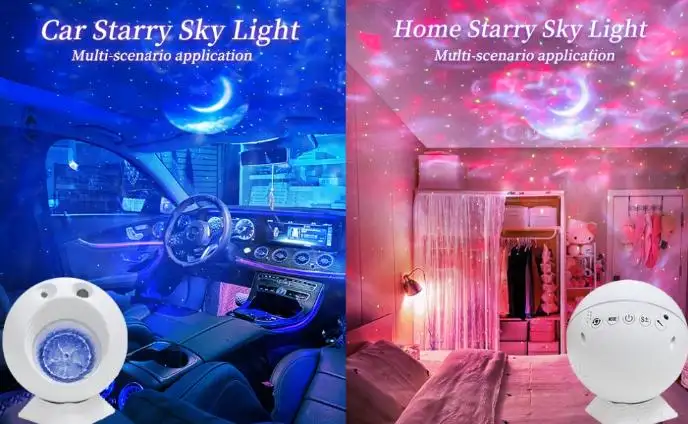
Mobility changes how you design a product. We keep the footprint compact and the mass balanced so the unit rides securely in a backpack, camera case, or glove compartment. Cable-free operation is not a bonus – it’s the baseline. A rechargeable system removes the extension-cord hunt, reduces trip hazards, and lets you put light exactly where camera angles, seating, and stage lines demand it.
Under the shell, our energy management keeps output steady as the battery discharges. That means brightness and motion speed don’t fade halfway through a set, an overnight routine, or a three-hour shoot. For planners and parents alike, consistent output translates into predictable run time and fewer interruptions. In small rooms, the lack of cables also keeps the footprint neat: no adapters snaking across floors or over nightstands.
n What to look for when buying:
• Runtime at realistic brightness. Ask for figures at 50 – 70% brightness, not just “up to” times at the dimmest setting.
• Charging convenience. USB-C input and compatibility with common 5V or PD chargers speed turnaround between sessions.
• Battery protection. Look for overcharge, short-circuit, and thermal safeguards that preserve cell health during travel.
Optics That Feel Natural, Not Gimmicky
Atmosphere depends on light quality and motion discipline. Our approach is to render stars and nebulae with depth, while maintaining uniformity across the projection field. Harsh edges and abrupt steps in motion pull you out of the scene, so we focus on smooth gradients and synchronized transitions.
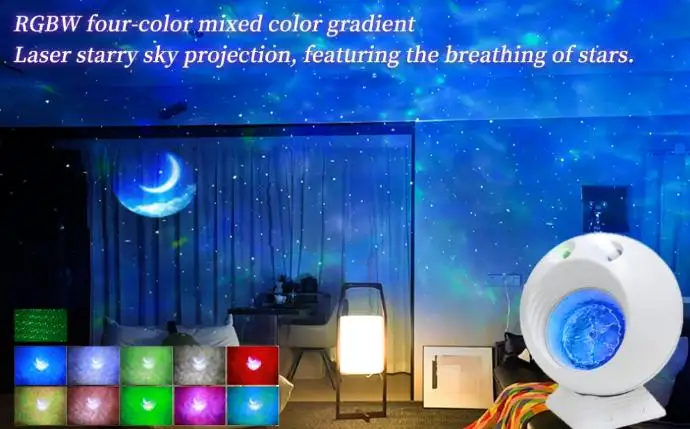
• Star field: Laser-based “breathing” stars fade gently to mimic a night rhythm rather than flicker. We tune the pulse to avoid visual fatigue.
• Nebula cloud: Diffused, multi-layer blending creates soft cloud contours without banding. You can run stars alone, nebula alone, or both.
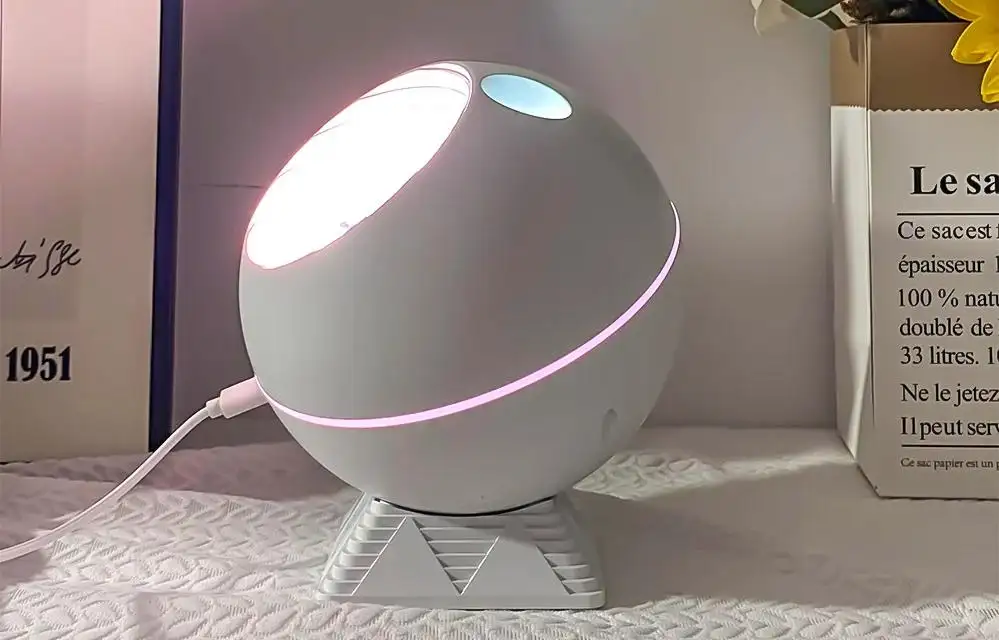
• Color control: An RGBW waist ring on the housing adds a subtle glow you can match to brand palettes or mood presets. Clean color mixing avoids the oversaturated cast that cameras hate.
• Consistency: High-frequency dimming prevents visible flicker in most camera setups, and motion control keeps drift smooth at slow and fast speeds.
n Practical tuning tips:
• For sleep: stars on, nebula at low intensity, slow drift, warm waist ring color. Set a timer so the unit powers down after the routine.
• For brainstorming or editing: bump brightness, modest motion to keep energy up without visual chaos.
• For video backdrops: choose a slower cloud speed and medium star density to avoid moiré on fabrics and retain detail on faces.
Controls That Reduce Friction, Not Add It
Control schemes should get out of the way. The point is to go from concept to scene in seconds. With a Rechargeable Starry Sky Projector Night Light, the essentials are immediate: brightness and motion speed adjust quickly, star-only or star-plus-nebula toggles, and a timer that actually shuts down reliably after the set period. For party setups and B-roll, sound-reactive mode listens to music and animates in sync. A handheld remote lets you operate from a chair, car seat, or console without crossing cables or bumping a tripod.
n Field-proven control strategies:
• Build two or three presets you can reach quickly: Sleep, Focus, and Show. Each should define brightness, motion speed, and color accent.
• In sound mode, start with moderate microphone sensitivity to avoid false triggers from ambient noise; then fine-tune for the room.
• For kids’ rooms, cap the maximum brightness and enable a short timer during school nights.
Mounting That Works in Cars, Homes, and Studios
Mounting flexibility is where many projectors stumble. We use a magnetic base that locks onto metal surfaces and lets you pivot to hit ceilings, headliners, or side panels without blocking sightlines. At home, that same magnet and a stable base help resist tipping on shelves or nightstands. In studios, multi-angle projection makes it easier to frame background texture without introducing glare into the lens.
Deployment playbook:
• In vehicles: position the base away from airbags and driver sightlines; angle the beam to wash the headliner rather than the windshield; secure the cable (if charging while in use) along trim lines.
• At home: place the unit 1 – 2 meters from the surface for balanced coverage; point past reflective frames or mirrors to avoid hotspots.
• In studios: if you’re mixing with key lights, start with lower nebula brightness and test star density against your shutter speed to prevent artifacts.
Note on magnets: keep a small buffer between the base and magnetic-stripe cards or older hard drives. Modern phones are generally safe, but it’s still wise to avoid direct contact.
Safety, Durability, and Quiet Operation
Tools that run near beds, cameras, and consoles must stay quiet and safe. We build housings from heat-stable materials and route thermal loads away from touch points. Long-life LEDs and a conservative drive profile maintain output over time. Quiet fans – or in some builds, passive cooling – keep the sound floor low so you can sleep, record, or host without hum.
- What we validate during production:
• Thermal stability under continuous operation.
• Optical uniformity after vibration and aging tests to simulate travel.
• Motion accuracy and timer reliability over repeated cycles.
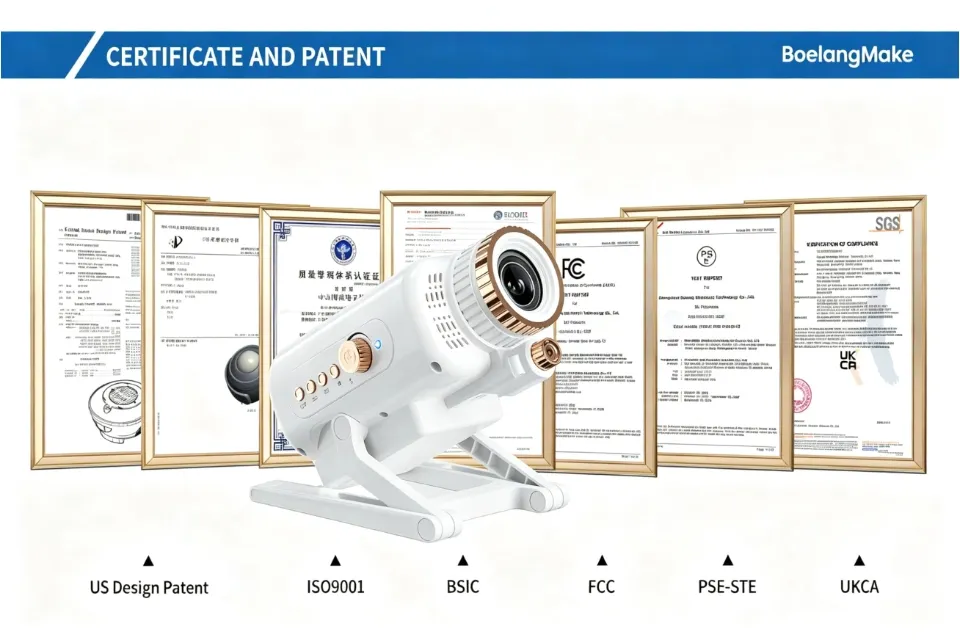
• Compliance with common safety marks and materials directives.
- A quick safety checklist for buyers:
• Confirm laser classification suitable for consumer use and that beams are fully diffused for ceiling projection.
• Verify automatic shutoff via timer or low-battery protection.
• Look for certifications (e.g., CE, FCC, RoHS) appropriate for your region.
- Use cases that pay off in the real world:
Because it’s rechargeable and compact, you can take it places corded gear can’t go – cars, pop-up venues, backyard tents, and temporary sets.
• In the car: add a celestial canopy for road trips or parked meetups without dangling wires. Pair it with a low-profile power bank for extended sessions.
• At home: transform a bedroom into a calm zone for wind-down routines; in living rooms, layer ambient light for game nights and guests.
• In studios: create textured backdrops for product videos, podcasts, and music sessions. The smooth drift keeps motion interesting without stealing focus.
• At events: skip power strips on stage edges. Cable-free deployment cleans sightlines and shortens setup and teardown.
Buying Guidance From a Manufacturer‘s Lens
If you’re evaluating options – or planning an OEM/ODM brief – prioritize what will matter in the field.
• Power: ask for truthful runtime curves (low/medium/high), charge time, and whether it runs while charging without dimming.
• Optics: insist on demo footage at close, medium, and long throws; check for banding, speckle, and edge harshness.
• Controls: test the timer for accuracy, the sound mode for sensitivity range, and remote responsiveness at typical distances.
• Mounting: examine magnet strength and the articulation range; if you need tripod mounting, ask about a 1/4-20 insert option.
• Acoustics: listen for fan noise at high brightness in a quiet room. Under 30 dB is a good benchmark for bedrooms and studios.
• Serviceability: confirm warranty terms, spare availability, and firmware support if the unit includes advanced modes.
A simple field kit to keep with the projector:
• Short USB-C cable plus a high-quality 5V/3A wall adapter.
• A small metal disk with adhesive backing for non-metal surfaces.
• Soft pouch to prevent lens scuffs in transit.
• Gaffer tape for discreet cable runs when charging during use.
Why Bolang
From the first CAD sketch to the last production test, we design for predictable behavior. That means smooth optics, reliable timers, quiet operation, and battery systems that don’t surprise you at the worst moment. For teams that travel, record, and host, the difference is obvious the first week you put the unit to work.
If your roadmap calls for a Rechargeable Starry Sky Projector Night Light that integrates cleanly into cars, homes, studios, and event rigs, we’re ready to help. Ask us for a demo, request sample units, or start an OEM/ODM conversation. We can tune the RGBW waist ring to match your brand, refine optical modes for your audience, and validate mounting solutions for your deployment patterns. The result: an atmosphere you can dial in on demand – portable, cable-free, and engineered for the real world.