Galaxy Projector Manufacturer in China for OEM and ODM Custom Projection Solutions
 FACEBOOK
 TWITTER
 LINKEDIN
Selecting a Galaxy Projector Manufacturer in China is not simply a matter of comparing projector wattage, housing styles, or unit prices. A galaxy projector is an integrated optical-electronic system in which the light source, lens architecture, motorized effect module, control electronics, thermal structure, and enclosure all influence the final projection.
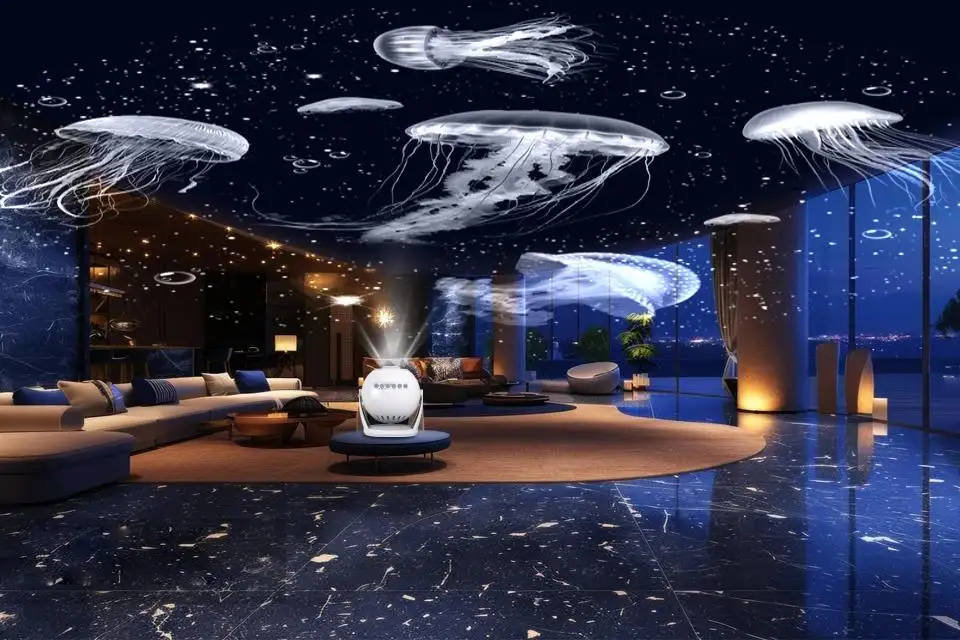
For OEM and ODM buyers, this matters because changing the projection area, visual depth, star density, control method, or operating environment can require changes to the optical and mechanical design—not just a different logo or packaging.
As a Galaxy Projector Manufacturer in Zhongshan, China, BoelangMake’s galaxy projector development is approached from this system level, combining semiconductor laser technology, LED lighting, optical structures, electronic controls, prototyping, and mass-production validation.
How a Galaxy Projector Produces Nebula, Stars, and Motion
Most galaxy projectors use several optical layers rather than a single light source.
LED or RGBW for the Background Layer
RGB and RGBW LEDs are typically used to generate broad-area effects such as:
• Nebula clouds;
• Aurora-like color fields;
• Water-ripple effects;
• Soft ambient illumination.
RGBW architecture adds a dedicated white-light channel. This can improve pastel tones, reduce over-saturation, and create more natural transitions than producing white by mixing RGB channels alone.
Laser for High-Definition Star Points
Laser light has much lower beam divergence than conventional LED illumination, making it suitable for concentrated star points and high-contrast patterns.
A laser module must be engineered around more than visible brightness. Key variables include:
• Wavelength;
• Optical output;
• Beam divergence;
• Pattern distribution;
• Scanning or diffraction structure;
• Laser classification and exposure limits.
For a Galaxy Projector Manufacturer in China, increasing laser power without considering beam distribution and safety is an invalid approach to engineering.
Motion Creates the Dynamic Effect
Transforming light to a galaxy could be done utilizing rotating diffraction elements, mechanical motors, optical components (movable), and/or rotating digitally projected elements.
The speed of the motor affects:
Visual Rhythm → Movement Of The Scene → Mechanical Noise → Life Of The Motor
Using faster motors to achieve a better visual effect is not always the right approach. Slow motion with a lot of smooth rotation could be better to use in bedrooms or in areas that are considered to be of low activity, whereas fast motion could be better suited for areas that are considered to be of high activity such as an event.
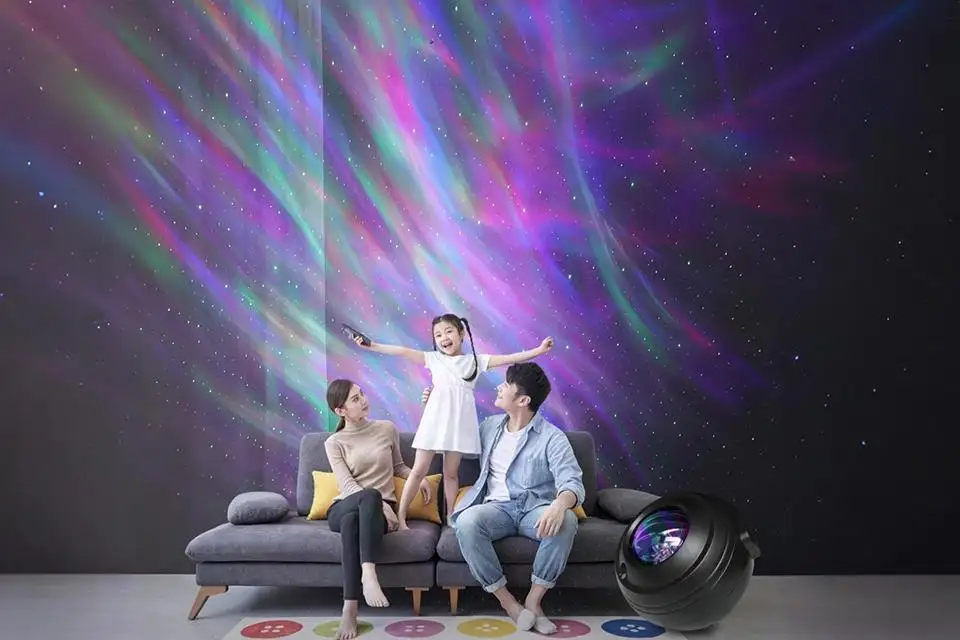
LED vs. Laser vs. Hybrid Projection
The optical platform should be selected according to the required visual effect.
| Technology | Projection Character | Main Advantage | Design Limitation |
| LED / RGBW | Soft, wide color fields | Smooth color mixing | Lower point definition |
| Laser | Sharp, high-contrast points | Strong star visibility | Requires stricter optical safety control |
| LED + Laser | Layered nebula and stars | Greater visual depth | More complex thermal and optical integration |
| Digital / 3D | Animated scene content | Flexible visual storytelling | Higher electronics and content requirements |
BoelangMake develops laser and laser-LED hybrid systems for home ambient projection, landscape lighting, stage applications, and hotel environments. This gives the engineering team a broader optical platform when developing custom projector effects.
What Actually Determines Projection Quality?
Projection quality cannot be judged by coverage area alone.
Projection Distance, Coverage, and Illuminance
Increasing projection distance usually enlarges the projected image, but the available light is distributed across a greater surface.
Therefore:
Longer Distance → Larger Coverage → Lower Illuminance Per Unit Area
A technically meaningful projector specification should consider:
• Recommended projection distance;
• Usable coverage;
• Room ambient light;
• Surface color;
• Optical output;
• Intended viewing effect
A 50 m² projection specification, for example, means little without knowing the distance and environmental conditions under which it was measured.
Lens Architecture and Optical Alignment
Lens quality influences:
• Center-to-edge sharpness;
• Beam distribution;
• Image distortion;
• Light uniformity;
• Effective projection angle
Even a well-designed optical system can perform poorly if the lens, laser module, and rotating optical components are misaligned during assembly. Optical positioning therefore becomes an important production-control parameter for any experienced Galaxy Projector Manufacturer in China.
Thermal Management Affects Long-Term Stability
Higher optical output produces more heat.
Thermal performance depends on the complete path:
Light Source → PCB → Heat-Transfer Structure → Housing → Surrounding Air
Poor heat dissipation can increase LED junction temperature, alter electronic performance, and shorten component life.
This is why optical power and thermal design should be developed together rather than treated as independent specifications.
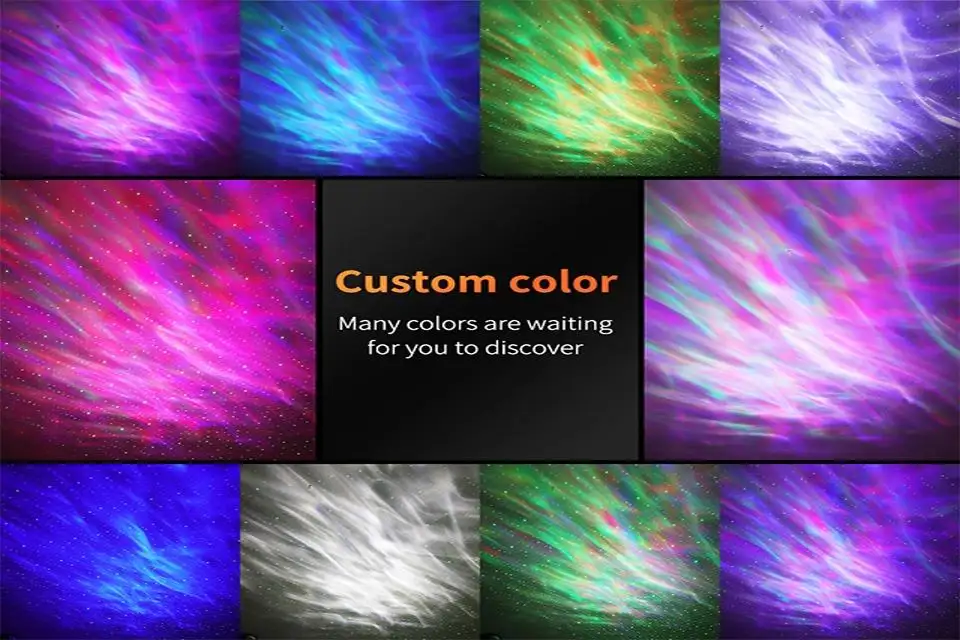
What Can Be Customized in an OEM Galaxy Projector?
OEM development can go far beyond logo printing and private-label packaging. A professional Galaxy Projector Manufacturer in China can customize multiple technical layers according to the target application and market.
Optical Effects
Adjustable projection performance features include:
• Patterns of firefly galaxies and nebulas
• Laser star distribution and density
• Water ripple or aurora effects
• Holiday scenes with projections
• Rotation speed and direction
Also, performance features can be customized as follows:
• Brightness with time controls
• Memory with scene sequencing
• Synchronizing with music
• Control with a remote
• Bluetooth or Wi-Fi
• APP with voice control
Mechanical Design
Structural changes can cover:
• Housing shape and dimensions;
• Surface finish;
• Mounting angle;
• Heat-dissipation structure;
• Indoor or outdoor enclosure design;
• Interfaces and cable routing
Branding and Accessories
OEM projects can also customize logos, product labels, packaging, manuals, and accessory combinations.
BoelangMake applies these capabilities across its indoor, outdoor, and 3D galaxy projector platforms, allowing customization to extend from appearance and branding to optics, controls, and structural engineering.
OEM and ODM Require Different Engineering Depth
OEM and ODM should not be treated as equivalent.
| Development Type | Typical Changes | Validation Required |
| Private Label | Logo, label, box | Visual inspection |
| OEM | Color, effects, controls, accessories | Functional testing |
| Deep OEM | Optics, electronics, structure | Prototype + reliability testing |
| ODM | New product architecture, mold, optics, firmware | Full engineering validation |
An OEM project normally modifies an existing technical platform.
ODM may involve:
Industrial Design → Optical Simulation → Electronics → Tooling → Prototype → Reliability Testing → Pilot Build → Mass Production
This explains why deeper customization generally requires longer engineering and validation cycles.
Indoor, Outdoor, and 3D Projectors Need Different Structures
Application environment should be defined before optical development begins.
Indoor Galaxy Projectors
Indoor products usually prioritize:
• Low operating noise;
• Compact dimensions;
• Smooth brightness control;
• APP or remote operation;
• Timers and sleep-oriented functions.
Outdoor Galaxy Projectors
Outdoor products introduce additional requirements:
• Moisture protection;
• Outdoor cable design;
• Mounting stability;
• Temperature tolerance;
• Longer projection distance;
• Enclosure sealing and drainage.
An outdoor projector is therefore not simply an indoor projector with a waterproof shell.
3D Galaxy Projectors
Digital or 3D projection changes the system architecture again. Instead of relying only on rotating optical patterns, digital content can create animated planets, galaxies, and spatial scenes. This increases the importance of imaging electronics, thermal control, content processing, and projection optics.
Why Batch Consistency Is as Important as the Prototype
A visually successful sample does not automatically guarantee stable mass production.
Production consistency requires control of:
• LED color and brightness variation;
• Laser output;
• Optical alignment;
• Motor speed and noise;
• PCB performance;
• Housing assembly;
• Temperature rise
With 5,000+ square meters of manufacturing space and more than 5 fully automated production lines, BoelangMake has their finished product inspection and burn-in testing. This helps discover optical, electronic, motor, and thermal abnormalities prior to shipment.
Compliance Must Be Based on Final Product
Compliance should be verified on a product level and not assumed based on the factory.
BoelangMake has BSCI/WCA factory certifications and is involved with product related requirements such as CE, FCC, FDA, UL, RoHS, PSE and TÜV testing.
However, professional sourcing should still confirm whether the documentation covers:
• The exact projector model;
• Laser configuration;
• Power adapter;
• Wireless functions;
• Target country;
• Final OEM/ODM modification
Changing a laser module, wireless PCB, adapter, or enclosure may affect the applicable test scope.
From Projection Concept to Manufacturable Product
The role of a capable Galaxy Projector Manufacturer in China is ultimately to convert a visual concept into measurable engineering requirements.
A successful project connects:
Application → Optical Architecture → Projection Distance → Visual Effect → Control System → Thermal Design → Safety → Manufacturing Validation
As a galaxy projector manufacturer in China, BoelangMake maintains 15+ R&D engineers and 5+ automated lines across a 5,000+ m² facility. Learn about our factory and quality control → HERE
- https://www.bolangmake.com/about-us/
FAQs
Q1. What kinds of galaxy projectors does BoelangMake offer?
BoelangMake sells indoor and outdoor galaxy projectors. They also sell galaxy projectors for personal use and entertainment, for staging, and for commercial use. These projectors use 3D, laser, and other advanced technologies. In addition, BoelangMake provides a variety of other projection-related products.
Q2. Does BoelangMake provide OEM and ODM for galaxy projectors?
Yes, BoelangMake does both OEM and ODM for their galaxy projectors. BoelangMake has their own team of designers and engineers, so they handle everything from the optics to the packaging.
Q3. What are the capabilities for OEM galaxy projectors?
Customizations include changing the colors, effects, control of the equipment, speed, timers, remote control, packaging, and the projection housing. Viewing instructions can also be added as well as a logo.
Q4. Does BoelangMake offer custom projections?
Yes, BoelangMake makes custom projects for projections. Effects can include star scenes, galaxy scenes, nebula scenes, ripple water scenes, laser-light distribution scenes, and custom other effects. They also mix the lasers with LED’s.
Q5. Does BoelangMake offer both LED and laser galaxy projectors?
Yes, they make both. BoelangMake has the equipment to make laser and LED technologies.